

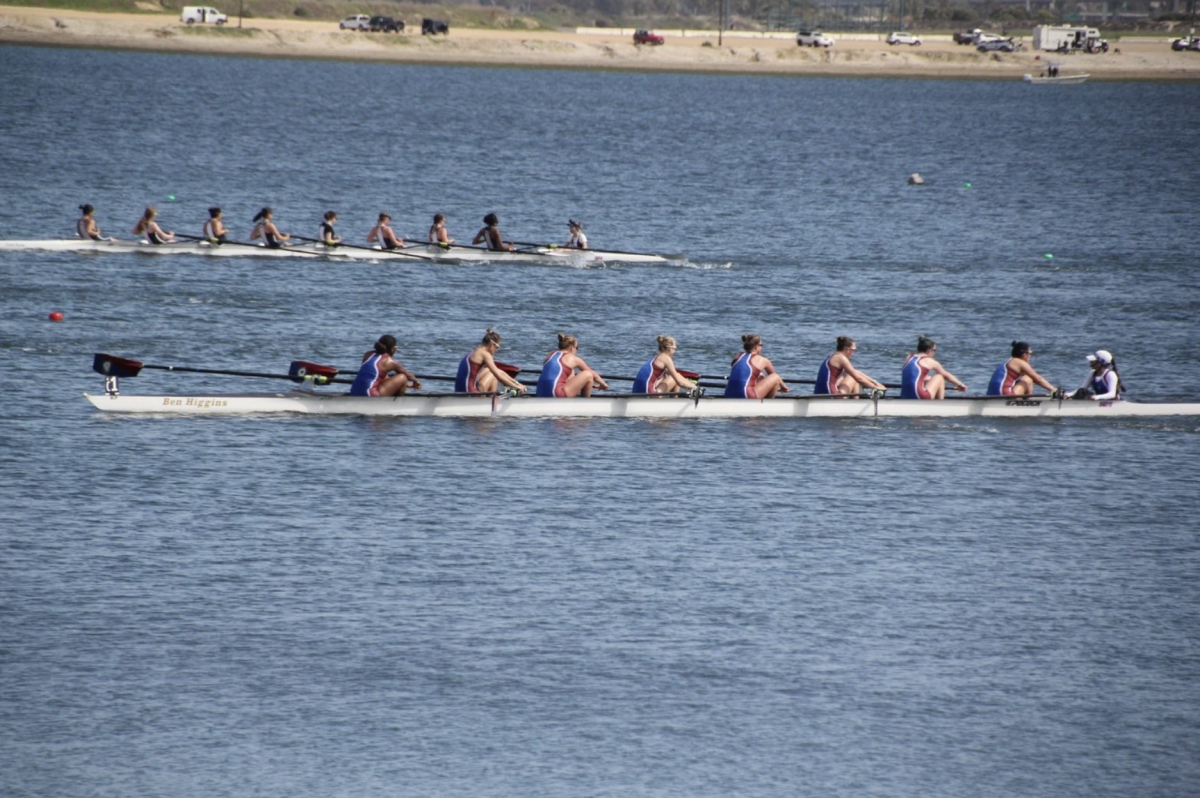
Sixteen-year-old Fiona Crosby spent weekend after weekend chasing soccer tournaments across the nation, constantly working toward boosting her ranking. She never imagined that in less than a year she would be committed to Villanova University – for crew.
With the relentless pressure of college admissions, many teens are constantly searching for new ways to distinguish themselves, especially as prospective college athletes. Some have taken up crew, more commonly known as rowing, to earn Division I athletic scholarships; three Pali seniors have found crew to be an unexpected but extremely rewarding path.
According to Next College Student Athlete (NCSA) College Recruiting, women’s crew teams are multiplying in colleges and universities to stay compliant with Title IX gender-equity regulations, which require schools to offer more balanced athletic opportunities for men and women. As a result, female rowing programs have expanded to offset male-dominated sports like football.
The NCSA explained that college rowing recruiters care more about 2,000-meter erg times (the standard rowing measurement), academics, technique, height and strength than about past experience. In other words, raw potential can be as important as years of training.
Crosby is a testament to this. Late into her junior year, after playing soccer for over a decade, she said that she realized that it would be “impossible to get recruited for soccer.” Her dad, a two-time world champion rower at Brown University, recommended switching from the pitch to the water.
“I finally tried out for Marina Aquatic Center (MAC) Rowing in January, and it clicked,” Crosby said. “I loved the atmosphere and how hard everyone worked for one another.”
After school, Crosby would make the hour-long drive to Marina del Rey for a two-plus-hour practice. She noted that although most of her team was highly competitive and working toward recruitment, no one was selfish.
“You have to work as a team in rowing and you have to show up for one another,” she said. “It’s not like soccer where one person can make or break it.”
Crosby said that she reached out to college crew recruiters with programs she liked and accepted her first offer, which also happened to be her top school. She readily admitted that her race time wasn’t the fastest on her team, but it was her persistence, dedication and height that made her stand out.
Rowing recruiters clearly favor a physique like Crosby’s – an above-average height and the strength to move the boat. But crew is not limited to naturally athletic teens; it also includes a position that opens up the opportunity of recruitment for teens with a smaller build: the coxswain. As the team leader and the one who steers the boat, the coxswain plays a pivotal role in crew.
Hannah Altman took on the role in her sophomore year with hopes of continuing her dad’s legacy of coxing at a university. She ended up accepting an offer from the same place as her dad, Syracuse University.
Reaching her goal took perseverance, though. A year earlier than Crosby, Altman joined MAC Rowing, unsure if she would have a successful future in the sport. Now, she asserts that it was a decision she doesn’t regret.
“Being a shy tenth grader in a facility with a bunch of people who were way taller than [I am] and already knew one another, it definitely took time to learn how to come out of my shell and not be afraid to speak up,” Altman reflected, highlighting the fact that she came into the sport as an introvert and is now headed to Syracuse University as a leader.
While the sport has been rewarding for rowing newcomers such as Crosby and Altman, it can be an even stronger scholarship pathway for those with more experience. Sofija Milic started rowing during the COVID-19 pandemic in seventh grade and has not stopped since, landing her an offer from the University of California, Berkeley, one of the top-ten best colleges for rowing.
“I didn’t really think about what I was getting into or how attached I’d get to the sport,” Milic said. “Honestly, I didn’t even know what rowing was when I first started; I got to practice the first day and had no idea what I was doing.”
Milic ended up embarking on a competitive team at California Yacht Club less than a year after her first practice. Three years later she joined MAC Rowing, after Crosby and Altman.
She said her schedule and workouts were and continue to be “both mentally and physically draining but rewarding.” Now, she looks forward to Cal’s strong community for her “as both an athlete and a student.”
Milic, like her Pali teammates, felt her work ethic and teamwork were what really set her apart: “I was not the fastest person. I think it’s the amount of grit and physical endurance and all the things I really worked on throughout my junior year that really got me to this point.”
Conversely, senior Isabella Drake has played volleyball for more than five years, but was recruited to Curry University’s Division III program late in the process, as a senior.
Despite dedicating 10 hours a week to the sport and starting as an opposite for Pali’s varsity girls volleyball team, Drake said getting recruited is especially hard considering there is much competition.
“Volleyball is definitely one of the harder sports to get committed to,” Drake said. “On my club team this past year, I was one of the most intense and experienced players, but there is so much competition.”
National Collegiate Athletic Association (NCAA) statistics back this up, as fewer than 4% of female volleyball players are committed each year.
Drake’s experience with volleyball, an extremely competitive high school sport, highlights the appeal of crew: it is a more secure recruitment path. However, Drake said that “no matter what sport you’re playing, if you’re committed to a college, that’s an accomplishment.”
For Crosby, Altman and Milic, crew has served as more than just a road to recruitment – it’s a lesson in discipline, teamwork and resilience.
Or, as Milic concluded: “Rowing is what you put into it.”